Call For a Free Quote! 0800 840 2112
ESC Surfacing • Technical homeowner guide

What does “tar and chip” actually mean on a driveway quote?

Surface dressing — often called tar and chip or spray and chip — applies a thin film of bituminous binder followed by carefully graded stone chippings. It is a textured, economical surface treatment, but its success depends on the strength and condition of the construction beneath it.

  • Spray-and-chip process explained
  • Hot bitumen versus bitumen emulsion
  • Single and double dressing methods
  • Loose chippings and aftercare

Calculate your driveway area

An accurate written quotation starts with the dimensions. We calculate your approximate area, then assess the build-up, drainage and access during a survey.

Area: — m²

This calculates area, not an unverified price. Materials, excavation, edges, falls and drainage are individually specified. Forms use ESC's existing website handler and require testing after publication.

Understand your quotation

What the surfacing description actually means

Surface dressing is usually most economical when the existing structural construction can be retained. “From scratch” requires a separate properly engineered base: the chippings and binder themselves are not a substitute for asphalt or concrete thickness.

ESC Surfacing's detailed written quotations should make it easier to see what is being built, what materials are specified, what preparation is included and what the finished driveway must do. The explanations on this page are educational examples, not a claim that every driveway has the same layers or thicknesses.

For an actual property the final specification depends on conditions discovered during the survey, any ground investigation, the chosen manufacturer’s system, anticipated vehicle loads, the available access and where surface water can legally go.

Important technical distinction: Despite its traditional nickname, contemporary surface dressing normally uses a bituminous binder — sometimes a hot applied binder, sometimes a suitable bitumen emulsion or modified formulation — not necessarily coal tar. The spray-and-chip layer is a thin surfacing treatment; it does not rebuild an unsuitable foundation.
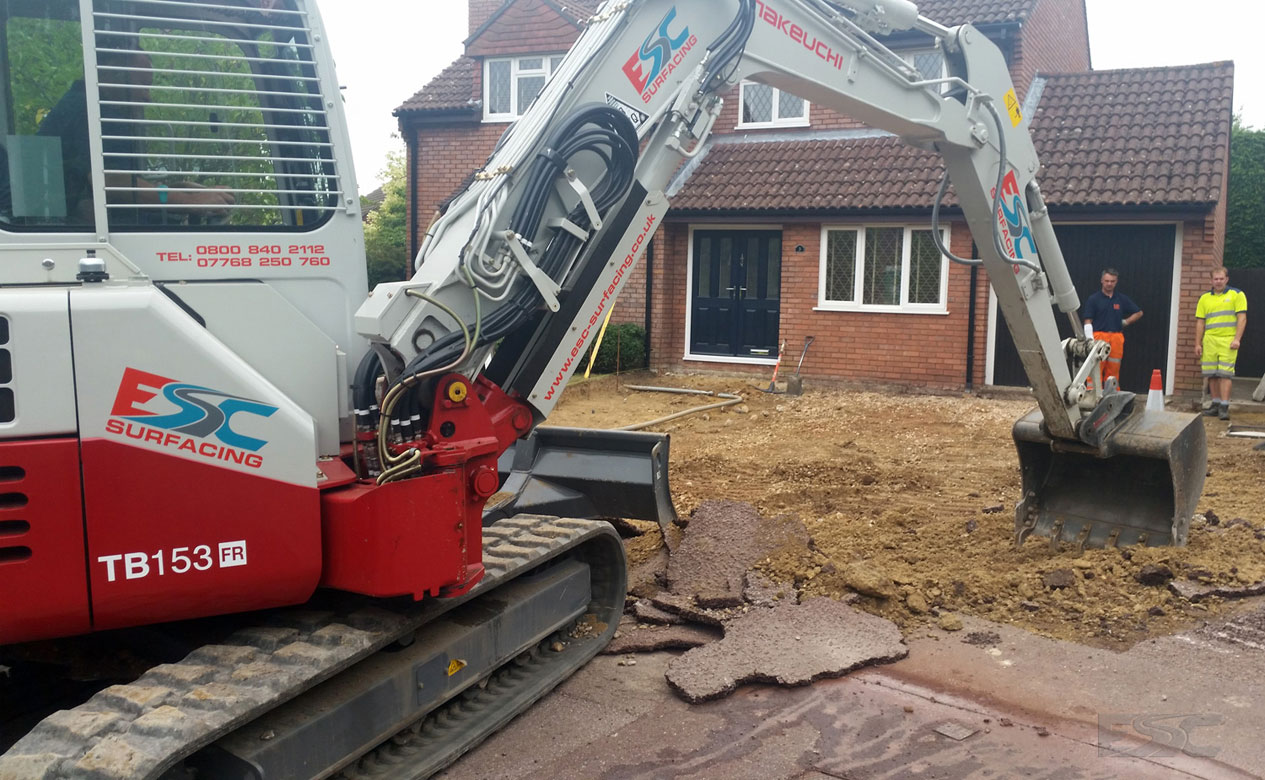
Excavator undertaking driveway groundwork before installing the selected finished surface
Ground preparation and excavation are shared stages of several driveway construction methods. This image illustrates the groundwork, not the selected finish.
Know which system you are buying

Two common construction options, clearly distinguished

There are alternatives within most driveway materials. The correct specification depends on the chosen finish and the drainage design.

Single surface dressing

One controlled application of selected bitumen binder is followed by one broadcast of clean, compatible graded chippings. The chippings are rolled into the binder and excess stone is removed after the material has developed sufficient adhesion. Coverage, weather and chip cleanliness are critical.

Best suited to: sound bound substrates where the single treatment is adequate for the intended domestic loading and appearance.

Double / multiple dressing

A specified design can use more than one binder/chip application, sometimes with different chipping sizes. It may provide an engineered texture or coverage where justified, but it uses different quantities and sequencing; it is not automatically “twice as strong”.

Important: the quote should state the number of binder and chip applications and product sizes.

Below the visible finish

What are the actual layers of this driveway?

The diagram shows the order of the typical layers from the top downward. It is conceptual: specify materials and compacted depths for the individual site, not by copying a generic diagram.

Illustrative cross-section

Selected roadstone chippingsTypically a carefully graded single-size stone such as approximately 6 mm or 10 mm, selected to suit appearance, binder and use.
Bituminous binder layerA controlled application of selected binder: hot bitumen, bitumen emulsion or a suitable modified system depending on the job.
Existing sound bound base or newly built baseOften asphalt or another suitable compacted bound surface. The treatment follows existing levels and defects unless they are corrected.
Sub-base / prepared formationThe load-bearing support below the base, with properly formed drainage and edges.

Not to scale • Actual layers vary with substrate, permeability and vehicle loads.

Why the base matters so much

When the ground beneath a drive is too weak or too wet, vehicle loads concentrate in the unsupported areas. The symptoms often appear at the surface: cracking, rutting, loose stones, standing water or edges that move.

The quotation should identify what is happening under the finish: removal and disposal, any geotextile, foundation aggregate, number of supporting courses, edge restraints and drainage connections.

Terms such as formation, compacted depth, sub-base and falls refer to separate things and should be stated clearly when relevant.

See technical definitions
Construction methodology

14 stages: from survey to the finished driveway

A full excavation and rebuild is shown here. Where a sound existing driveway can be retained, some foundation stages will not be needed — but this decision should be supported by an inspection.

  1. Survey the drive and identify the existing structure

    Check whether the present drive is sound enough for surface dressing. Look for cracks, rutting, potholes, loose material, oil, vegetation and water ponding. Assess vehicle loading, tight turning movements, gradient and the condition of edges.

  2. Agree the finish, chip size, binder and coverage

    Select the aggregate size and colour, binder system and whether single or double dressing is appropriate. The smallest decorative chip is not necessarily the best option for every turning area or traffic pattern. Specify the finish rather than a vague “tar and chip” label.

  3. Plan lawful drainage and edge details

    Dressing normally seals the underlying surface. Check falls and drainage routes; confirm surface water will not flow into the house, neighbour’s land or an unsuitable public drainage system. Drain channels or suitable outfalls may need installing beforehand.

  4. Check access, weather and protection

    Plan a safe delivery and storage route for hot or emulsified binder, aggregate and machinery. Protect gates, walls and planting from spray. Wind, rain, cold substrate, high humidity and other conditions can make the dressing unsuitable on the scheduled day.

  5. Excavate and rebuild where there is no sound base

    If constructing from bare ground, the driveway needs prepared subgrade, compacted structural sub-base and a suitable bound base before dressing. The cost of this underlying engineering must be included separately from the thin surface treatment.

  6. Carry out structural repairs and patching

    Repair failed areas properly before dressing. Cut out soft patches, repair potholes and reinstate stable asphalt where required. Bitumen and chippings will not prevent reflection of serious movement or permanently hide a failing foundation.

  7. Clean and dry the substrate

    Sweep away grit, mud, moss and loose debris. Attend to oil or other contamination according to the selected binder. Good adhesion requires an appropriately sound, clean and sufficiently dry surface.

  8. Set up binder and aggregate equipment

    Confirm the planned binder application rate, binder temperature or emulsion settings, spray bar/nozzle calibration, aggregate spread rate and rolling equipment. Binder and chippings need to be compatible and placed within the supplier’s working conditions.

  9. Apply the bituminous binder uniformly

    A controlled layer is sprayed over the prepared drive using suitable equipment. Too little binder can leave unbonded aggregate; too much can lead to bleeding and stone sinking. Avoid missed strips, puddling and spray contamination at boundaries.

  10. Broadcast the clean graded chippings

    Spread the selected stone promptly and evenly while the binder is ready to receive it. A calibrated chip spreader or suitable controlled hand application may be used depending on driveway size and access.

  11. Roll to seat the stones

    Use an appropriate roller to press the chippings into the binder without crushing them or causing drag. Rolling can need to follow the spreader promptly. Particular care is required at thresholds, edges, garage entrances and turning points.

  12. Apply any additional designed dressing layer

    If the specification calls for double dressing, follow the approved sequence and coverage rates for the extra binder and chippings. This is not simply adding loose gravel over the first finished layer.

  13. Allow initial setting and remove surplus stone

    Excess chippings are expected at first. Sweep or vacuum at the time suitable for the binder and site conditions; several follow-up passes may be necessary. Give precise instructions for reopening, careful driving and avoiding tight stationary steering.

  14. Final inspection, sweep and maintenance

    Inspect uniformity, bare spots, binder bleeding, patches, edges and drainage; return as needed to remove later loose chips. Explain periodic maintenance and the fact that surface dressing eventually wears and can need renewal.

Method statement versus quotation: A quotation explains the materials and work included; a method statement explains the safe, practical sequence of doing them. Not every item shown here is automatically included in every ESC quote.
Material specification

What the materials named in your quotation actually do

These are the main product and material categories you may see. Make sure any proprietary mixture follows its manufacturer’s installation requirements.

Material / item on quoteWhat it means and why it matters
Bitumen / bituminous binderThe black binding material holding chippings to the existing surface. A supplier can offer a hot-applied formulation, emulsion or modified system.
Bitumen emulsionFine bitumen droplets dispersed in water; the emulsion must break and cure so a binder film remains. Product selection and conditions are vital.
Polymer-modified binderA formulation altered to provide specified performance properties; not every domestic dressing requires it.
Graded stone chippingsClean durable, appropriately sized and shaped roadstone, commonly offered in differing colours and nominal sizes. They must adhere to the specified binder.
6 mm or 10 mm chippingsNominal grading descriptions, not the compacted thickness of a structural layer. Other gradings may be selected if appropriate.
Existing asphalt baseA common sound substrate for cost-effective dressing. It must be assessed and patched as necessary.
New structural base when requiredFor new driveways, formation, engineered sub-base and asphalt/bound base are priced and constructed as distinct work items.
Edge restraints and drainage channelsManage the appearance and mechanical stability of margins and provide a lawful route for water on an essentially impermeable finish.
Optional second binder/chipping applicationUsed only when the agreed surface dressing design calls for multiple treatments and specifies their rate and grading.

Layer depths and nominal aggregate sizes are different measurements. A “10 mm stone” describes the chipping grading — it does not mean a driveway is constructed to a 10 mm finished depth.

Plant, tools and equipment

What equipment is used, and why?

The range of equipment changes with driveway size, access, substrate and the chosen system. Some work is machine-laid; intricate borders and details require skilled manual work.

Mechanical brush or powered sweeper

Remove contamination before dressing and surplus chips after the treatment.

Binder distributor / spray lance

Apply a consistent rate of bitumen to the approved substrate.

Heating / emulsion-handling equipment

Control storage and application to match the selected product.

Chipping spreader

Broadcast graded chips consistently before the binder loses working time.

Appropriate roller

Seat and embed chips into the binder without damaging the aggregate.

Excavator, saw and asphalt tools

Repair broken patches and build a load-bearing base if necessary.

Measuring and calibration equipment

Control material coverage, spread width, site area and temperatures.

Protective sheeting and PPE

Protect property and operatives during binder and chipping application.

Reading a detailed estimate

Example items to look for in your written specification

This is a quotation-reading checklist rather than a statement of the precise specification ESC uses on every job. Your actual itemised quotation should replace assumptions with project-specific selections.

1 Existing base or full reconstruction

Make clear whether the quotation relies on an assessed sound driveway or includes excavation, sub-base and bound-base construction.

2 Single or double dressing

State each planned binder-and-stone application and its sequence rather than using an imprecise “2 coats” description.

3 Binder specification and application method

Identify suitable hot binder, emulsion or modified system and the specified coverage / rates where applicable.

4 Aggregate size, type and colour

Specify graded chipping, nominal size and any chosen decorative stone source/product.

5 Preparation and patch repairs

Price pothole repairs, crack treatment, sweeping and base reinstatement separately from the dressing.

6 Access restrictions, loose chips and follow-up

Set out likely initial excess chippings, sweeping schedule, careful-driving advice and responsibility for final inspection.

Always compare like with like: Two prices may cover different quantities of excavation, waste removal, groundwork, surface finish, stone selection, drainage and finishing details. Cost per square metre alone cannot establish whether the specifications are equivalent.
Searchable A–Z terminology

Technical words explained in plain English

Every construction method has its own specialised vocabulary. Search for a phrase from your quotation and compare it with the explanation below.

30 of 30 terms
10 mm stone
A nominal aggregate size category sometimes used in surface dressing.
6 mm stone
A nominal aggregate size designation, not automatically a finished layer thickness.
Adhesivity
How well the selected binder adheres to the aggregate.
Binder bleeding
Excess binder rising or becoming visible between chippings.
Bitumen
A petroleum-derived binding material widely used in modern asphalt and surface treatments.
Bitumen emulsion
Bitumen dispersed in water so it can be applied under controlled conditions.
BS EN 12271
British/European Standard describing performance requirements for relevant surface dressing products.
Chippings
Clean selected aggregate laid onto fresh binder.
Curing
The period during which the selected binder develops its intended adhesion and surface properties.
Double dressing
A designed treatment with multiple binder/chipping applications.
Embedment
The degree to which stone is pressed into the binder.
Emulsion break
Separation of water from the emulsion, leaving a bituminous film.
Hot-applied binder
A bituminous binder spread at an appropriate elevated working temperature.
Macrotexture
Large-scale surface texture created partly by protruding chippings.
Patching
Structural repair of individual failed areas before the surface treatment.
Polymer-modified binder
Bituminous product formulated with additives for selected properties.
Reflective cracking
Cracks from a failed underlying layer appearing through a new finish.
Rolling
Mechanically pressing the chippings into the binder.
Single dressing
One application of binder and one application of stone.
Spray and chip
Another description of spreading binder and then stone chippings.
Spray rate
Quantity of binder applied per unit area.
Spread rate
Quantity of chips delivered per unit area.
Stone loss
Chippings separating from the dressed surface after application or during service.
Substrate
Existing surface that receives the spray-on binder.
Surface dressing
A thin treatment of binder and chippings applied onto a supporting pavement.
Sweeping
Removing excess, unbound chippings after the appropriate bedding-in period.
Tar and chip
A colloquial name for surface dressing; modern binders are normally bituminous rather than traditional coal tar.
Trafficking
Vehicles using the newly treated surface once appropriately opened.
Waterproofing
Reducing the water entering the existing pavement structure through the dressed surface.
Wet skid resistance
Grip performance of a surface in wet conditions; depends on materials and texture.

No matching term. You can ask us directly about your quotation.

Homeowner questions

Frequently asked questions

These are the practical questions customers ask when reviewing a technical construction quotation.

What is a tar and chip driveway?

It is a surface-dressed driveway: a controlled layer of bituminous binder is applied to a sound supporting surface, graded stone is spread onto the binder and the chips are rolled in.

Is tar and chip the same as resin bonded gravel?

No. They may look similar, but tar and chip usually uses bituminous binder and is associated with surface-dressing techniques. Resin bonded uses a resin adhesive layer with aggregate broadcast into it.

Does tar and chip use real tar?

“Tar and chip” is a traditional nickname. Contemporary driveway work often uses bitumen or bitumen emulsion rather than coal tar; the proposed binder should be identified in your written quote.

Can a surface dressed driveway be built from scratch?

Yes, but not from binder and chippings alone. A new driveway needs properly designed formation, compacted supporting layers and usually a suitable bound base before the surface dressing is applied.

Can tar and chip go over an existing tarmac driveway?

Often yes when that surface is structurally sound and suitable for the chosen treatment. Failed patches, water problems and serious cracking should be repaired first.

Is surface dressing the same as asphalt resurfacing?

No. Asphalt resurfacing lays a new compacted asphalt course. Surface dressing is a comparatively thin binder-and-chippings treatment over an existing or newly built supporting surface.

What stone size is used for tar and chip driveways?

Domestic surface dressing may use nominal sizes such as 6 mm or 10 mm, but the correct grading depends on the design, available binder, traffic and desired texture.

Why are there loose stones after surface dressing?

The installer may spread more chips than eventually remain embedded so that the binder is fully covered. Controlled sweeping and initial careful traffic help remove or seat the surplus.

What does double dressing mean?

It is a specified multi-application treatment using more than one binder/chip pass. It is not automatically twice the load-bearing strength of a single treatment.

Will tar and chip stop cracks and potholes?

It can seal and protect a suitable surface, but serious cracking, failed foundations, movement and potholes require repair before dressing. It is principally a surfacing/protection treatment.

Is tar and chip permeable?

Conventional surface dressing generally forms an effectively water-resistant skin over the existing pavement. Drainage falls and lawful runoff management still matter.

Can tar and chip be laid in winter or rain?

The method is weather-sensitive. Surface moisture, cold and humidity can prevent binder performance and stone retention. The installer should follow the selected material’s minimum application requirements.

How soon can I drive on a tar and chip driveway?

Reopening depends on the binder, ambient conditions and chipping embedment. The contractor should give explicit access, speed, turning and sweeping instructions; an immediate-use promise is not suitable for every method.

Is tar and chip suitable for turning cars in a small driveway?

Tight tyre scrubbing and stationary steering can disturb a new dressing, especially during establishment. Product and stone selection, base quality and realistic use requirements should be agreed before installation.

Is surface dressing cheaper than a full tarmac rebuild?

It can be where a good supporting driveway already exists. If a complete foundation and asphalt base need constructing first, those items change the price substantially.

Technical and planning references

UK guidance and standards to read alongside your quote

Manufacturers’ full application manuals take precedence for specific proprietary products. Government guidance and standards are provided as background rather than as automatic guarantees of compliance on a particular property.

Note: standards for highways or large-area treatments do not automatically apply in full to every small private driveway. For example, BS EN 12271 has stated scope exclusions for certain small-area work. A competent contractor should select the appropriate specification for the job.

Explore your options

Compare with other driveway surfaces

The visible finish is only one part of a driveway. These guides explain how the base, drainage, surface and maintenance requirements vary by material.

Other driveway construction guide

Tarmac driveways

Learn about excavation, Type 1 stone, binder and surface asphalt, drainage and 125 Pen bitumen.

Read the tarmac driveways guide →
Other driveway construction guide

Block paving driveways

Explore paver thickness, bedding, herringbone laying patterns, edge restraints, joints and permeable options.

Read the block paving driveways guide →
Other driveway construction guide

Gravel driveways

See how a gravel drive is dug out, founded, contained, compacted and maintained, with or without stabilisation grids.

Read the gravel driveways guide →
Not sure which to choose?

Compare all five driveway finishes

View suitability, drainage, access, maintenance and appearance in one easy overview.

See the driveway comparison →
Need a detailed specification?

Ask us to explain every item in your driveway quote.

Tell us about your property, the vehicles you park and any drainage concerns.

Contact ESC Surfacing

Ask Us About Your Driveway Project

Have a question about your specification, materials or the construction process? Tell us about your project and we will explain the proposed works in plain English.

Send us a Message

What Our Customers Say

Read feedback from homeowners who have used ESC Surfacing. The reviews below are provided through our existing external review integration and independent profile links.