Call For a Free Quote! 0800 840 2112
ESC Surfacing • Technical homeowner guide

How do you build a gravel driveway that stays firm?

A properly built gravel driveway is not simply a lorry load of decorative stones tipped onto soil. The long-term performance comes from excavation, foundation strength, controlled surface depth, stable edges and water management. This guide explains all of them in the language of a detailed written quotation.

  • True construction from bare ground
  • MOT Type 1 and Type 3 explained
  • Gravel stabilisation grid options
  • Stone sizes, depth and drainage

Calculate your driveway area

An accurate written quotation starts with the dimensions. We calculate your approximate area, then assess the build-up, drainage and access during a survey.

Area: — m²

This calculates area, not an unverified price. Materials, excavation, edges, falls and drainage are individually specified. Forms use ESC's existing website handler and require testing after publication.

Understand your quotation

What the surfacing description actually means

The most durable choice is not necessarily the deepest pile of gravel. If the loose stone is too deep, wheels plough through it and pedestrians struggle. The supporting foundation must carry the load.

ESC Surfacing's detailed written quotations should make it easier to see what is being built, what materials are specified, what preparation is included and what the finished driveway must do. The explanations on this page are educational examples, not a claim that every driveway has the same layers or thicknesses.

For an actual property the final specification depends on conditions discovered during the survey, any ground investigation, the chosen manufacturer’s system, anticipated vehicle loads, the available access and where surface water can legally go.

Important technical distinction: Loose gravel can let rain enter the surface, but that does not guarantee the driveway drains into the soil below. A dense Type 1 base, clay, compacted fill or poor outfall can limit infiltration. Permeability is a property of the complete build-up, not simply the fact that the top layer consists of stones.
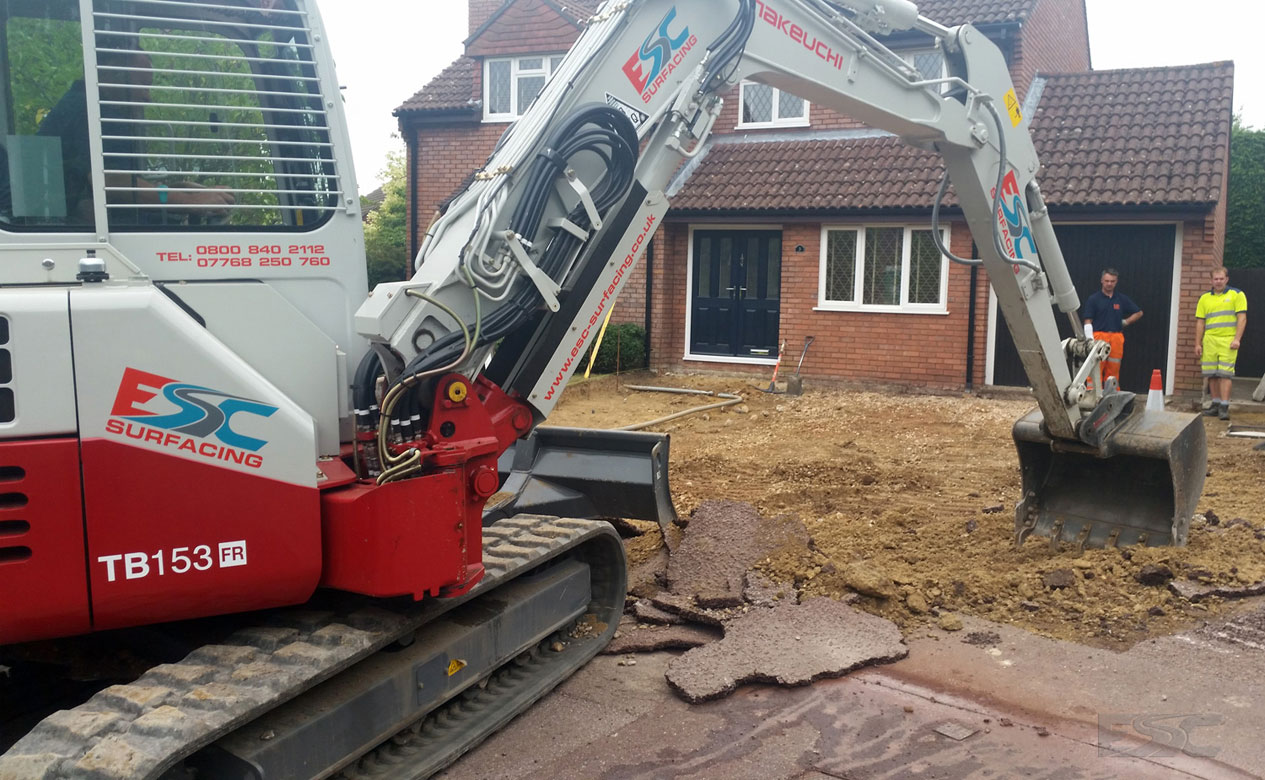
Excavator undertaking driveway groundwork before installing the selected finished surface
Ground preparation and excavation are shared stages of several driveway construction methods. This image illustrates the groundwork, not the selected finish.
Know which system you are buying

Two common construction options, clearly distinguished

There are alternatives within most driveway materials. The correct specification depends on the chosen finish and the drainage design.

Conventional loose-gravel driveway

Decorative angular gravel is installed as a controlled-thickness wearing course over a properly compacted stone foundation, with robust edging and planned surface drainage. It is comparatively easy to replenish or rake, but loose stones can scatter or form wheel tracks.

Best suited to: suitable gradients and homeowners happy with occasional levelling and topping up.

Stabilised gravel-grid driveway

A manufacturer-specified honeycomb or cellular stabilisation product supports the gravel layer and helps resist migration under vehicles and footsteps. Its bedding, fixings, fill depth and minimum cover must follow the chosen system.

Best suited to: sites requiring better stone retention and easier movement than loose gravel alone, subject to gradient and product limits.

Below the visible finish

What are the actual layers of this driveway?

The diagram shows the order of the typical layers from the top downward. It is conceptual: specify materials and compacted depths for the individual site, not by copying a generic diagram.

Illustrative cross-section

Decorative gravel / chippingsOften around 30–50 mm as a loose wearing course, chosen for grading, sharpness, intended loading and maintenance; grid products follow manufacturer fill-depth rules.
Optional gravel stabilisation gridA purpose-designed cellular grid for suitable sites, installed over its specified bedding with proper edge detail and filled to the required depth.
Compacted engineered sub-baseDense graded Type 1 for a conventionally drained driveway, or suitable open-graded stone where the system is deliberately designed to store/infiltrate water.
Geotextile where specifiedSuitable separation fabric helping prevent soil and stone mixing, installed at the design-approved location.
Prepared soil / formationFirm, adequately drained subgrade with weak spots treated before covering.

Not to scale • Actual layers vary with substrate, permeability and vehicle loads.

Why the base matters so much

When the ground beneath a drive is too weak or too wet, vehicle loads concentrate in the unsupported areas. The symptoms often appear at the surface: cracking, rutting, loose stones, standing water or edges that move.

The quotation should identify what is happening under the finish: removal and disposal, any geotextile, foundation aggregate, number of supporting courses, edge restraints and drainage connections.

Terms such as formation, compacted depth, sub-base and falls refer to separate things and should be stated clearly when relevant.

See technical definitions
Construction methodology

13 stages: from survey to the finished driveway

A full excavation and rebuild is shown here. Where a sound existing driveway can be retained, some foundation stages will not be needed — but this decision should be supported by an inspection.

  1. Measure and design for actual use

    Assess parking areas, gradients, wheel-turning locations, pedestrians, wheelchairs, bins, motorcycles, heavy vans and potential water runoff. Very steep drives or tight turning areas may be unsuitable for ordinary loose gravel.

  2. Choose the gravel and edging design

    Select angular graded chippings rather than assuming smooth, rounded pea shingle will lock together. Agree the colour, visible grading, edging style, transition to the footway and whether cellular stabilisation will be included.

  3. Confirm drainage and planning requirements

    In England, suitable gravel is listed as a permeable surface in front-garden guidance, but the supporting construction still needs a practical drainage design and any relevant property-specific consent. Check infiltration on clay and ensure no runoff reaches neighbouring property.

  4. Check services and prepare the work area

    Mark known pipes, cables and inspection covers. Protect boundaries, doorsteps and planting. Plan how excavated materials and imported aggregate will reach the site without damaging adjoining areas.

  5. Strip vegetation and remove existing construction

    Remove turf, weeds, old paving and other unsuitable materials. A weed-suppression membrane alone is not a substitute for ground preparation; roots and organic soil can decay and leave unstable pockets.

  6. Excavate to the required formation

    Allow the design depth for geotextile if used, compacted supporting aggregate, bedding under any grid and the chosen decorative stone finish. Avoid universal depths that do not account for soil strength and traffic.

  7. Inspect the subgrade and correct soft spots

    Examine the exposed ground for movement, wet clay and made ground. Remove weak areas or introduce suitable improvement; do not allow later stone layers to hide instability that will create wheel ruts.

  8. Install specified geotextile

    Use a separation/filter fabric where appropriate beneath the sub-base to prevent fines from pumping into the aggregate. Overlap and lay it to manufacturer guidance. Positioning depends on the complete construction; an ordinary weed-control sheet at the surface does not strengthen the subgrade.

  9. Place and compact the engineered sub-base

    Spread suitable stone in controlled layers and compact it with the correct vibrating plate or roller. Type 1 is common in conventional build-ups; if infiltration/storage is required, the specified open-graded stone and drainage arrangements may be different.

  10. Install secure edgings and entrance transitions

    Put in block, concrete, metal, timber or stone restraints suitable for vehicles and ground conditions. Their role is to contain the gravel and stop it migrating onto the footway, pavement, lawn or neighbouring property.

  11. Fit any stabilisation grids and bedding

    Prepare a suitably level and compacted underlying course, then install grids, joiners, anchors and edge details as the supplier specifies. Grid systems vary: do not assume one cell height, fill method or load rating applies to every product.

  12. Spread and level the gravel layer

    Lay the specified stone evenly at the intended depth or fill level of the chosen grid. Avoid leaving an excessively deep loose surface: cars may churn it and walking or cycling becomes difficult.

  13. Inspect, tidy and issue maintenance guidance

    Check edge containment, drains, surface levels, grid coverage and wheel-track susceptibility. Hand over guidance for raking, removing leaf litter and silt, replenishing lost gravel and avoiding high-speed or stationary wheel spinning.

Method statement versus quotation: A quotation explains the materials and work included; a method statement explains the safe, practical sequence of doing them. Not every item shown here is automatically included in every ESC quote.
Material specification

What the materials named in your quotation actually do

These are the main product and material categories you may see. Make sure any proprietary mixture follows its manufacturer’s installation requirements.

Material / item on quoteWhat it means and why it matters
Angular gravel / crushed chippingsAngular stones tend to interlock better under vehicles than rounded pebbles. A grading such as 10–20 mm may be considered depending on the appearance, use and specification.
Decorative stone depthOften an approximately 30–50 mm wearing layer for loose systems, but it must suit the chosen stone and base; excessively deep gravel is difficult to drive and walk on.
MOT Type 1A compactable, dense graded granular sub-base used in conventional driveway construction. It is not a freely draining reservoir.
Type 3 / 4–20 mm open-graded stonePotentially suitable for permeable drainage storage or transmission when the complete system has been designed for that purpose.
Separation geotextileA suitable filter fabric separating the supporting soil and aggregate; not automatically the same product as a surface-level weed-suppression membrane.
Gravel stabilisation gridHoneycomb or cellular panel that helps retain stones in position. Rating, base preparation, cell size and stone grading differ between products.
Edging and containmentConcrete kerb, block border, metal edge or other suitable restraint limiting spread at grass, walls and footways.
Specified grid beddingThe product-approved levelling or bedding material beneath grids, installed at the intended depth and stability.
Drainage componentsA soakaway, porous construction, channel drain or other suitable destination where required. Water reaching the surface does not guarantee it can soak into clay.
Subgrade stabilisation materialsGeogrid, capping aggregate or additional sub-base may be selected when site investigation reveals weak or variable ground.

Layer depths and nominal aggregate sizes are different measurements. A “10 mm stone” describes the chipping grading — it does not mean a driveway is constructed to a 10 mm finished depth.

Plant, tools and equipment

What equipment is used, and why?

The range of equipment changes with driveway size, access, substrate and the chosen system. Some work is machine-laid; intricate borders and details require skilled manual work.

Excavator and tipper

Remove turf, excavation spoil and unsuitable existing surface.

Rotating laser and levelling staff

Control falls, finished levels and formation.

Compaction plate / roller

Compact the supporting stone layer correctly.

Geotextile tools

Cut, lap and secure separation fabric without damage.

Rakes and levelling lutes

Distribute stone evenly and finish to the required depth.

Concrete and kerbing tools

Install stable edge restraints and entrance details.

Grid cutting tools

Shape stabilisation panels to curves and edges as manufacturer permits.

Wheelbarrows or mechanical spreader

Move and place gravel without disturbing prepared support.

Reading a detailed estimate

Example items to look for in your written specification

This is a quotation-reading checklist rather than a statement of the precise specification ESC uses on every job. Your actual itemised quotation should replace assumptions with project-specific selections.

1 Excavation and disposal

Record existing surface removal, planned ground reduction and who disposes of excavated material.

2 Subgrade preparation / geotextile

Define weak-ground treatment and the grade, purpose and location of any fabric or geogrid.

3 Structural sub-base

Specify the aggregate type, e.g. Type 1 for conventional build-up or a designed open-graded system, and compacted depth.

4 Stone description and quantity

State the actual decorative stone type, nominal grading, colour and intended finish depth.

5 Grids, edges and entrances

Detail stabilisation product, bedding, anchors, kerbs and treatment where the driveway meets the public footway.

6 Drainage, maintenance and exclusions

Describe infiltration/runoff design, site limitations, topping-up and expected movement of loose stones.

Always compare like with like: Two prices may cover different quantities of excavation, waste removal, groundwork, surface finish, stone selection, drainage and finishing details. Cost per square metre alone cannot establish whether the specifications are equivalent.
Searchable A–Z terminology

Technical words explained in plain English

Every construction method has its own specialised vocabulary. Search for a phrase from your quotation and compare it with the explanation below.

32 of 32 terms
10–20 mm aggregate
A typical size range describing the stones, not the depth of the finished layer.
4/20 aggregate
An open-graded stone size designation used in some permeable sub-base designs.
Angular chippings
Crushed stones with defined edges that tend to interlock better than smooth rounded stones.
Attenuation
Temporary storage of water, with controlled later discharge.
Capping layer
Additional construction layer helping bridge poor ground in an engineered design.
Cell fill
Stone placed into the cavities of a gravel stabilisation grid.
Compacted depth
Thickness after mechanical compaction, not the loose spread thickness.
Corrugation
Ridges or ripples that can form in loose gravel under traffic or braking.
Decorative aggregate
The visible selected stone used as the driveway wearing finish.
Drainage fall
Small designed slope directing surface water to its intended destination.
Edging restraint
Firm boundary controlling migration and finished levels.
Formation
Prepared underlying ground surface after excavation.
Geogrid
Stiff reinforcement layer used where engineered ground improvement is appropriate.
Geotextile
Specified permeable separation and filtration fabric.
Gravel grid
Cellular or honeycomb product helping contain stone and reduce movement.
Gravel migration
Stone travelling out of the driveway due to traffic, wheels or slope.
Grid cover
The required depth of stone over a stabilisation grid, where specified by its maker.
Infiltration
Water soaking into the soil below a correctly designed draining pavement.
Pea gravel
Generally rounded small gravel; aesthetically attractive but more prone to migration under tyres.
Permeable construction
A complete pavement system that allows water to enter and then safely be managed below the surface.
Proof rolling
Assessment of the response of prepared ground to a specified load or compaction method.
Raking
Redistribution of the loose stones to maintain an even surface.
Replenishment
Adding matching gravel over time to replace material lost through normal use.
Rutting
Permanent wheel-track depressions caused by movement in the surface or supporting construction.
Soakaway
Designed infiltration structure that receives runoff and transfers it into suitable soil.
Sub-base
Structural compacted layer spreading wheel loads into the ground.
Subgrade
Natural or made ground carrying the driveway layers.
Traffic loading
Expected weight, frequency and turning forces from vehicles using the drive.
Type 1
Dense graded compactable aggregate commonly used under conventional driveways.
Type 3
Open-graded stone used in some permeable construction systems.
Washout
Movement of fine material or stones by uncontrolled flowing water.
Weed membrane
Generic weed-suppressant material; it is not automatically a suitable structural separation geotextile.

No matching term. You can ask us directly about your quotation.

Homeowner questions

Frequently asked questions

These are the practical questions customers ask when reviewing a technical construction quotation.

How is a gravel driveway built from scratch?

Remove unsuitable existing material, excavate to formation, inspect the ground, add designed geotextile where needed, build and compact the supporting sub-base, install edging, then spread a controlled depth of decorative gravel or fill a specified stabilisation grid.

Does a gravel driveway need a sub-base?

A driveway carrying vehicles normally needs an engineered supporting construction. Decorative gravel directly on topsoil can sink, mix with mud and develop deep ruts.

What is the best size of gravel for a driveway?

Angular gravel in a range such as approximately 10–20 mm is often considered for private drives. The right choice depends on expected traffic, gradient, wheelchair or bin access and the desired appearance.

Should I use MOT Type 1 below gravel?

Type 1 is a commonly specified compacted foundation for a conventional gravel driveway. A fully permeable drainage design may require open-graded materials instead, so the correct answer depends on where rainwater must go.

What is the difference between Type 1 and Type 3?

Type 1 contains a mix including fines and becomes relatively dense when compacted. Type 3 is typically open-graded, with voids helping water move or be stored in a suitable permeable system.

Do I need weed membrane under gravel?

A properly specified geotextile may separate soil and aggregate and reduce mixing. A thin generic weed-control sheet is not a replacement for excavation, compaction or the correct structural foundation.

How thick should a layer of gravel be?

For many conventional loose systems the wearing course is around 30–50 mm, although the approved stone size and site use dictate the depth. Excessively deep loose gravel creates difficult wheel tracks and walking conditions.

Do gravel stabilisation grids work?

Suitable quality grids can reduce stone movement and improve walking/rolling practicality when they are installed with the correct base, bedding, fill and edge detail. They do not fix a weak foundation.

Can a gravel driveway be permeable?

Yes, gravel can admit water, but true drainage depends on the compacted sub-base, underlying soil and outfall. Dense Type 1 or clay soil may restrict infiltration despite an open-looking surface.

Is gravel suitable for a steep driveway?

Loose gravel can migrate and be difficult to control on steep gradients. A specific retention system might help within its limits, or a more stable surface such as tarmac, block paving or an appropriate resin system could be better.

Will gravel damage my tyres?

Properly selected clean driveway aggregate is widely used, but sharp oversized stone, excessive depth, migration onto roads and high-speed spinning can cause problems. Specify an appropriate grading and maintain it.

Why does my gravel driveway keep getting ruts?

Ruts often result from a weak or inadequately compacted base, too much loose gravel, regular tight turning or poor drainage. Simply adding more decorative gravel may hide rather than solve the cause.

Can I convert an old gravel drive to tarmac?

Often, subject to investigation. The existing loose gravel and foundation would be assessed, and the correct bound base, edging and asphalt layers constructed. It is not generally a matter of laying hot asphalt directly over loose gravel.

How often will I need to top up gravel?

That depends on traffic, depth, grading, slope, edges and weather. Periodic raking and occasional additions are normal for a loose-gravel system; a good foundation and containment reduce ongoing work.

Technical and planning references

UK guidance and standards to read alongside your quote

Manufacturers’ full application manuals take precedence for specific proprietary products. Government guidance and standards are provided as background rather than as automatic guarantees of compliance on a particular property.

Note: standards for highways or large-area treatments do not automatically apply in full to every small private driveway. For example, BS EN 12271 has stated scope exclusions for certain small-area work. A competent contractor should select the appropriate specification for the job.

Explore your options

Compare with other driveway surfaces

The visible finish is only one part of a driveway. These guides explain how the base, drainage, surface and maintenance requirements vary by material.

Other driveway construction guide

Tarmac driveways

Learn about excavation, Type 1 stone, binder and surface asphalt, drainage and 125 Pen bitumen.

Read the tarmac driveways guide →
Other driveway construction guide

Block paving driveways

Explore paver thickness, bedding, herringbone laying patterns, edge restraints, joints and permeable options.

Read the block paving driveways guide →
Not sure which to choose?

Compare all five driveway finishes

View suitability, drainage, access, maintenance and appearance in one easy overview.

See the driveway comparison →
Need a detailed specification?

Ask us to explain every item in your driveway quote.

Tell us about your property, the vehicles you park and any drainage concerns.

Contact ESC Surfacing

Ask Us About Your Driveway Project

Have a question about your specification, materials or the construction process? Tell us about your project and we will explain the proposed works in plain English.

Send us a Message

What Our Customers Say

Read feedback from homeowners who have used ESC Surfacing. The reviews below are provided through our existing external review integration and independent profile links.