

Call For a Free Quote! 0800 840 2112

ESC Surfacing · Berkshire & surrounding areas

How much does a tarmac driveway cost?

The size of a driveway matters, but it is only one part of the price. A sound surface that can be overlaid is a different job from an area that needs excavating, rebuilding and new drainage. Here is how to make sense of the figures before arranging a survey.

Arrange a free survey
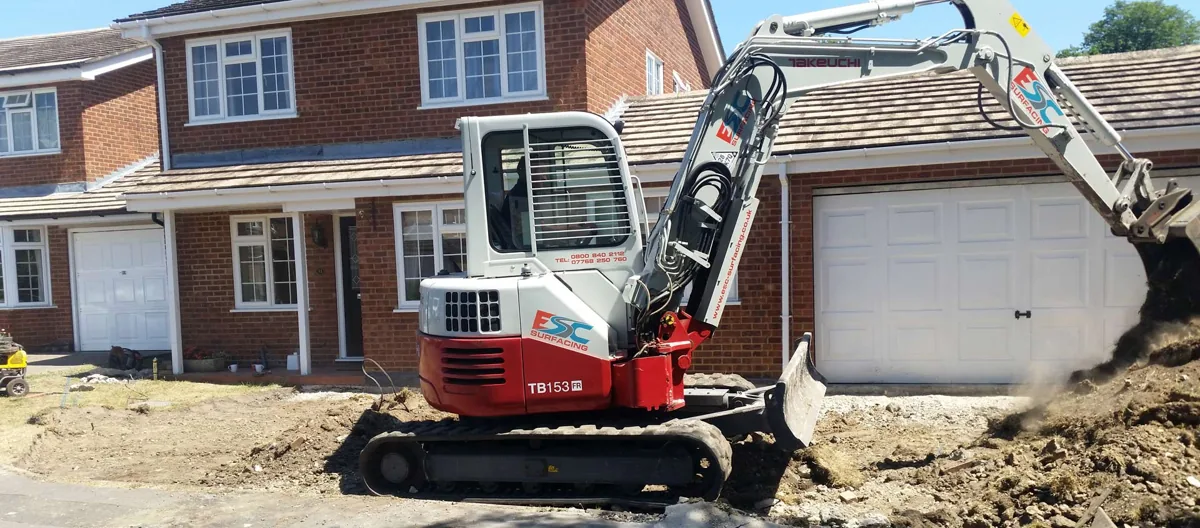
Excavation equipment used for driveway preparation

Indicative tarmac driveway prices

The examples below use the same guide rates as our existing driveway estimator: £65 per m² for a standard black tarmac overlay and £110 per m² for a full dig-out, before VAT and site-specific adjustments. These are starting figures for discussion, not a fixed tariff or an offer to carry out every job at that rate.

Illustrative estimates using ESC’s guide rates
ExampleRange before VATWith 20% VATMain assumption
50 m² black tarmac overlay£2,925–£3,575£3,510–£4,290Existing construction is suitable to overlay.
50 m² black tarmac, full dig-out£4,950–£6,050£5,940–£7,260A straightforward reconstruction; actual preparation is surveyed.
20 m² black tarmac overlay£2,500–£2,750£3,000–£3,300The estimator’s minimum charge governs this small area.

Guide checked October 2026. The VAT-inclusive column assumes the standard 20% rate; the written quotation confirms the treatment for your work. GOV.UK VAT guidance for building work.

Allow for the complete job. New kerbs, drainage, difficult access, unexpected ground conditions and other project-specific work can change these figures. The estimate range is not a contingency allowance for every possible extra.

Our estimator applies a higher square-metre allowance below 30 m² and a £2,500 minimum before VAT. Small jobs still need a crew, equipment and deliveries, which is why multiplying a large-area rate by a few square metres can be misleading. The estimator also allows 15% extra for red tarmac; confirm the actual material and availability when requesting a quotation.

What changes the price?

What is already there

Stable construction may be reusable. Movement, deep cracking or soft areas can mean removing more material and rebuilding the support below the surface.

Excavation and disposal

The amount to remove, ground conditions and access for taking spoil away affect time and transport. Ask what excavation and disposal are included.

Levels and water

A drive that sends water towards a garage may need more than a fresh finish. Channels, outlets, falls and thresholds should be considered together.

Edging and details

New kerbs, block borders, access-cover adjustments and connections to paths add work. Agree the details before comparing totals.

Access and working space

A narrow approach or limited delivery space can change how the job is carried out. Tell us about gates, overhead obstructions and shared access.

How the drive will be used

A driveway used by cars needs a different assessment from an area regularly carrying delivery vehicles. Tell us about the heaviest expected vehicles.

Is an overlay the cheaper option?

It can be, when the existing driveway provides suitable support and there is room for the added surface. It is poor value if it hides movement or leaves finished levels too high at a threshold. Our repair and resurfacing guide explains what needs checking before an overlay is recommended.

Compare quotations on the same basis

Ask each contractor to describe the area, preparation, proposed layers, edging, drainage, disposal and VAT. A lower total may exclude work that another quotation includes. Photographs and approximate measurements help us start a conversation; a site visit is needed to establish a dependable specification.

  • Measure the main rectangle and any separate turning or parking spaces.
  • Photograph the entrance, existing damage, drain covers and thresholds.
  • Note where water collects after rain.
  • Explain which parts of the work are essential and which finishes are optional.

For the materials behind the quotation, see how a tarmac driveway is built.

What a properly itemised driveway quotation should explain

A useful quotation does more than state a price per square metre. It should make clear which construction is proposed and what is included. Two driveways of the same size can need very different preparation: an existing sound hardstanding may require less work than one with unstable ground, severe ponding or several changes of level.

Preparation and removal

Check whether the price includes lifting the current surface, excavating unsuitable material, removing waste from site and preparing the formation. Ask what happens if soft spots are discovered after excavation.

Supporting layers and finish

Confirm whether a new sub-base or binder layer is included, the proposed surface material and nominal layer thicknesses, and whether the specification suits cars, vans or heavier regular traffic.

Edges, levels and drainage

Ask how the new surface will meet the pavement, garage, door threshold and neighbouring areas. Kerbs, drainage channels, manhole adjustments and a suitable outfall should be accounted for where required.

Access, VAT and aftercare

Confirm access for plant and deliveries, any traffic restrictions, how long the driveway needs to be kept clear, the VAT position and what the installer recommends for first use.

Example: why the same 50 m² can cost differently

Imagine two driveways each measuring approximately 50 m². One has an intact, well-supported base and falls that direct water to an appropriate place. Subject to inspection, an overlay may be possible. The other has multiple sunken patches, broken edges and water collecting against the house. Its quote may need to allow for removal, rebuilding, levels and drainage. Comparing their surface-only prices would hide the more important difference in scope.

Small or awkward sites also behave differently from large open areas. Vehicle and equipment mobilisation, restricted access, manual handling and shaping around covers can form a larger proportion of the total. A square-metre guide is therefore useful for an initial conversation, not a substitute for the measured specification.

Questions to ask before accepting a price

  • What work is included below the visible surface, and what existing construction is being retained?
  • How are rainwater, finished levels and any relevant permissions being handled?
  • Will the quotation identify optional items and the method for agreeing additional work?
  • What is the anticipated sequence, including site access and when vehicles can return?
  • Is the quotation based on a visit and a stated specification rather than photographs alone?

See our planning and drainage advice and construction guide to understand what the specification means.

Discuss your project with ESC

Tell us where the work is and what you would like to improve. We can discuss the next step and whether a site visit is needed.

We use your details to respond to this enquiry. Read our privacy policy. To send photographs, email Email ESC Surfacing.

Prefer to talk? Call 0800 840 2112.