Call For a Free Quote! 0800 840 2112
ESC Surfacing • Technical homeowner guide

How is a block paved driveway built properly?

Block paving is a carefully engineered assembly of individual paving units, bedding material, joint fill, a compacted foundation and strong edge restraints. The driveway’s strength comes from the complete interlocking construction, not the visible blocks alone.

  • Conventional vs permeable paving
  • Bedding, joints and compaction
  • Herringbone and laying patterns
  • Concrete, clay and setts compared

Calculate your driveway area

An accurate written quotation starts with the dimensions. We calculate your approximate area, then assess the build-up, drainage and access during a survey.

Area: — m²

This calculates area, not an unverified price. Materials, excavation, edges, falls and drainage are individually specified. Forms use ESC's existing website handler and require testing after publication.

Understand your quotation

What the surfacing description actually means

The block thickness matters, but failures often begin underneath: poorly compacted stone, excessively thick bedding, missing restraints or inadequate drainage.

ESC Surfacing's detailed written quotations should make it easier to see what is being built, what materials are specified, what preparation is included and what the finished driveway must do. The explanations on this page are educational examples, not a claim that every driveway has the same layers or thicknesses.

For an actual property the final specification depends on conditions discovered during the survey, any ground investigation, the chosen manufacturer’s system, anticipated vehicle loads, the available access and where surface water can legally go.

Important technical distinction: Standard close-jointed block paving is usually treated as an impermeable or limited-permeability driveway for drainage design. Purpose-designed permeable concrete block paving uses different blocks, wider/open joints, washed angular bedding and an open-graded sub-base — not ordinary kiln-dried jointing sand.
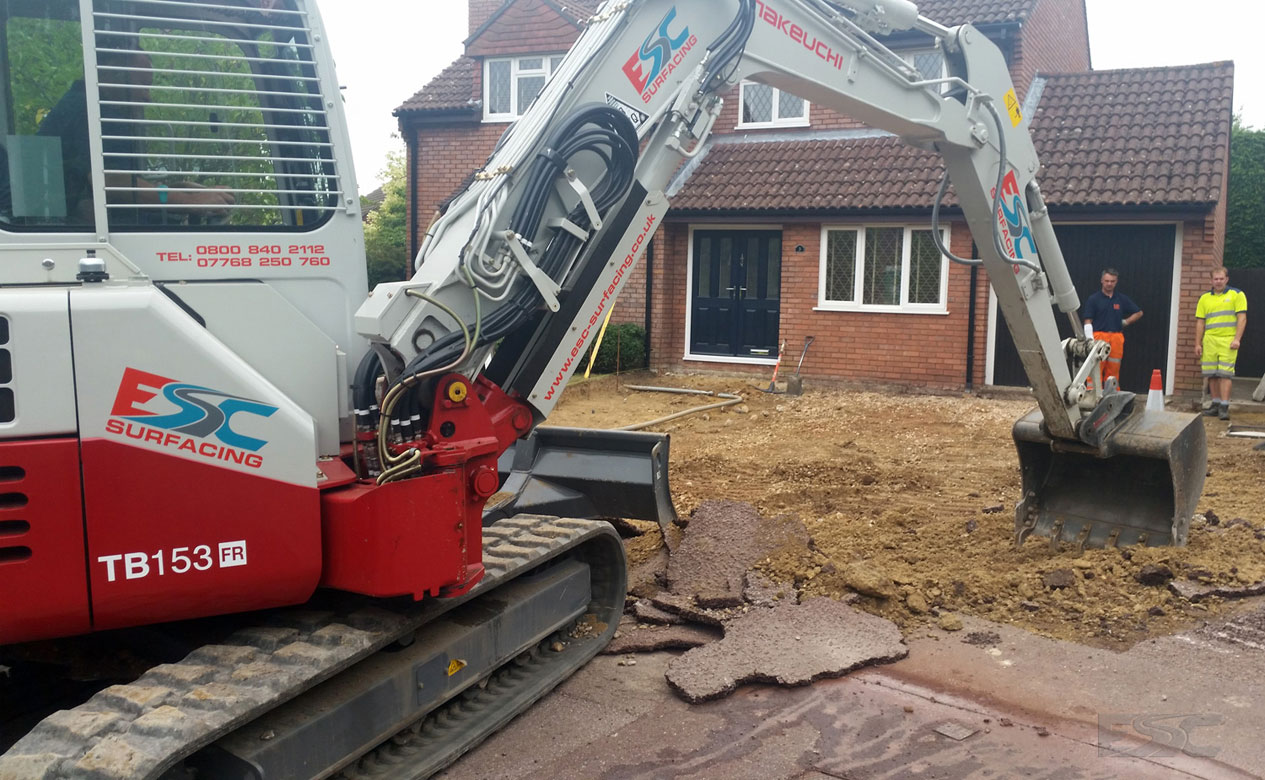
Excavator undertaking driveway groundwork before installing the selected finished surface
Ground preparation and excavation are shared stages of several driveway construction methods. This image illustrates the groundwork, not the selected finish.
Know which system you are buying

Two common construction options, clearly distinguished

There are alternatives within most driveway materials. The correct specification depends on the chosen finish and the drainage design.

Conventional flexible block paving

Concrete or clay pavers sit on a carefully levelled granular laying course. The tight joints are filled with fine, dry jointing sand and the complete surface is consolidated with an appropriate plate compactor. Strong, concrete-backed perimeter restraints prevent the interlocked area spreading under tyre loads.

Rainwater: mainly dealt with using surface falls, channels and a suitable discharge route.

Permeable concrete block paving (CBPP)

Purpose-designed permeable blocks are laid with small, engineered openings between them. Water enters through clean open-graded jointing aggregate and travels into compatible bedding and sub-base. The system needs storage/infiltration or a controlled outlet; it is not achieved by leaving standard block-paving joints unfilled.

Rainwater: managed through the whole construction, subject to ground conditions and system design.

Below the visible finish

What are the actual layers of this driveway?

The diagram shows the order of the typical layers from the top downward. It is conceptual: specify materials and compacted depths for the individual site, not by copying a generic diagram.

Illustrative cross-section

Paving blocks / settsCommon domestic concrete blocks are often 50–60 mm or more, depending on design and expected traffic; product selection is specification-led.
Bedding / laying courseA controlled, uniform course of suitable sand in conventional flexible paving, often around 30–50 mm after compaction; permeable systems use specified clean angular aggregate.
Compacted sub-baseOften Type 1 graded aggregate beneath conventional flexible paving, with the depth selected for ground strength and vehicle loads.
Prepared subgradeStable formation with necessary excavation, drainage provision, soft-spot treatment and separation materials.

Not to scale • Actual layers vary with substrate, permeability and vehicle loads.

Why the base matters so much

When the ground beneath a drive is too weak or too wet, vehicle loads concentrate in the unsupported areas. The symptoms often appear at the surface: cracking, rutting, loose stones, standing water or edges that move.

The quotation should identify what is happening under the finish: removal and disposal, any geotextile, foundation aggregate, number of supporting courses, edge restraints and drainage connections.

Terms such as formation, compacted depth, sub-base and falls refer to separate things and should be stated clearly when relevant.

See technical definitions
Construction methodology

13 stages: from survey to the finished driveway

A full excavation and rebuild is shown here. Where a sound existing driveway can be retained, some foundation stages will not be needed — but this decision should be supported by an inspection.

  1. Measure the driveway and vehicle requirements

    Record the parking layout, turning movements, car and van weights, slope, thresholds, service covers and kerb connection. Decide whether concrete blocks, clay pavers or stone setts are appropriate and agree a layout and edge finish.

  2. Design drainage and check consents

    Set the finished levels before excavation. For conventional paving, calculate falls towards a suitable landscaped area or collector. For a permeable system, assess infiltration and storage, water table, soil and outlet. Check front-garden planning and separate dropped-kerb requirements.

  3. Remove turf and old materials

    Lift defective paving, excavate soil and remove unsuitable material. Set out protection to neighbouring walls, planting and footways. Waste and excavated material should have a clear removal/recycling route.

  4. Excavate to formation level

    Excavate sufficiently for the finished paving, bedding, compacted sub-base, any ground treatment and drainage. The necessary depth is a design result, not a universal “dig 200 mm” instruction.

  5. Proof the subgrade; treat soft areas

    Check bearing and stability of the exposed soil. Remove unsuitable soft spots, compact as appropriate and introduce geotextile, capping or reinforcement where specified. Never conceal mud or unstable fill beneath bedding sand.

  6. Build the sub-base in compacted layers

    Spread the specified Type 1 or other approved conventional sub-base in suitable lifts, compacting with appropriate plant. For permeable construction use the specified clean open-graded stone and design storage depth, with compaction and drainage controls.

  7. Install solid perimeter edge restraints

    Lay kerbs, blocks on a concrete bed, setts or other restraint to line and level, with a suitable concrete backing/haunch. Edges keep the body of blocks from creeping outward as vehicles brake and turn.

  8. Install drainage and adjust covers

    Position channel drains, gullies and service access covers at their designed levels. Protect existing inspection access and match cover frames to the finished block surface. Make sure channels have a real legal drainage destination.

  9. Spread and screed the laying course

    Use the specified clean bedding material at an even, controlled thickness. Conventionally this is a suitable laying sand; permeable paving uses a different open-graded laying aggregate. Do not treat deep bedding as a substitute for a level sub-base.

  10. Lay the blocks in the agreed pattern

    Start from a reliable straight datum and maintain line, joint width, bond and the chosen pattern. Herringbone — commonly 45° or 90° — is often selected for vehicle areas because it helps interlock the block matrix.

  11. Cut and detail perimeters carefully

    Use a saw or suitable splitter for neat cuts around curves, drainage, steps and inspection chambers. Avoid unstable slivers and visually inconsistent tiny cuts wherever the setting-out can be adjusted.

  12. Compact and fill all joints correctly

    After laying, use a suitable vibrating plate with appropriate protection where necessary. For conventional paving, apply dry jointing sand, compact, refill and repeat until joints are properly filled. For permeable paving, use the system’s specified clean angular joint aggregate — not sand.

  13. Inspect finished levels and trafficking

    Check falls, alignment, lipping, blocks that rock underfoot, incomplete joints and low spots. Explain expected settlement checks, additional jointing sand requirements, cleaning, and when the surface can be used.

Method statement versus quotation: A quotation explains the materials and work included; a method statement explains the safe, practical sequence of doing them. Not every item shown here is automatically included in every ESC quote.
Material specification

What the materials named in your quotation actually do

These are the main product and material categories you may see. Make sure any proprietary mixture follows its manufacturer’s installation requirements.

Material / item on quoteWhat it means and why it matters
Concrete blocks — BS EN 1338Manufactured pavers for pavements. Product class, shape and thickness should be selected for the expected use; the name of a colour or shape does not tell you the strength.
Clay pavers — BS EN 1344Fired clay paving products with distinct colour and surface properties. Their dimensions, suitability and price differ from concrete blocks.
Natural stone settsCut or cropped stone modules such as granite or sandstone. Bedding and jointing systems vary by unit type and design.
Type 1 granular sub-baseDense graded stone commonly used beneath a conventional driveway. Compaction and correct thickness are essential.
Bedding sand / laying courseA suitable graded sand for conventional flexible block paving. It is not bulk building sand, a general levelling fill or a substitute for proper ground preparation.
Kiln-dried jointing sandFine dry sand brushed into traditional close joints, supporting interlock and resisting movement; it can need topping up after settlement or cleaning.
Open-graded jointing and bedding stoneClean angular aggregate designed for permeable paver systems. Leaving voids through the construction is essential to water movement.
Type 3 or 4/20 open-graded sub-baseMaterials that can support load while holding and conveying rainwater in appropriately designed permeable pavements.
Concrete bed and haunchRigid foundation and backing installed for kerbs, edging and other restraints to resist lateral tyre forces.
Geotextile / geogridSpecified separation, filtration or reinforcement materials based on ground and paving-system requirements.

Layer depths and nominal aggregate sizes are different measurements. A “10 mm stone” describes the chipping grading — it does not mean a driveway is constructed to a 10 mm finished depth.

Plant, tools and equipment

What equipment is used, and why?

The range of equipment changes with driveway size, access, substrate and the chosen system. Some work is machine-laid; intricate borders and details require skilled manual work.

Laser level, string lines and square

Establish falls, alignments, joint rows and accurate levels.

Excavator and tipper

Remove existing ground and excess material.

Vibrating plate / compactor

Compact the sub-base and consolidate the laid blocks.

Screeding bars and straightedge

Produce the controlled bedding course.

Block splitter and diamond saw

Cut units accurately and safely to boundaries.

Rubber mallet and laying tools

Adjust individual block positions without damage.

Soft brush

Work appropriate dry jointing material fully into joints.

Drainage and concrete equipment

Install channels, concrete restraints, bedding and haunching.

Reading a detailed estimate

Example items to look for in your written specification

This is a quotation-reading checklist rather than a statement of the precise specification ESC uses on every job. Your actual itemised quotation should replace assumptions with project-specific selections.

1 Paver brand, material and thickness

Specify concrete or clay, the actual product, thickness, colour and agreed pattern. “Premium blocks” alone is not an engineering description.

2 Dig-out and disposal

State whether the existing base is removed, disposal included, how much excavation is expected and what happens if soft areas are discovered.

3 Sub-base material and compacted depth

Define conventional Type 1 or the specific permeable system and indicate finished compacted depths, not loose delivery depths.

4 Bedding and jointing

State laying course material, expected layer depth, sand or permeable joint aggregate and completion method.

5 Edge restraint and drain details

Describe block edging, concrete bed/haunch, slopes, channels and legal outlet or infiltration plan.

6 Inspection, maintenance and exclusions

Clarify service covers, additional jointing after settling, access to underground services, defects and the written guarantee.

Always compare like with like: Two prices may cover different quantities of excavation, waste removal, groundwork, surface finish, stone selection, drainage and finishing details. Cost per square metre alone cannot establish whether the specifications are equivalent.
Searchable A–Z terminology

Technical words explained in plain English

Every construction method has its own specialised vocabulary. Search for a phrase from your quotation and compare it with the explanation below.

32 of 32 terms
Basketweave
A decorative arrangement of paired or grouped pavers.
Block paving
A modular surface of individual concrete or clay units laid in an interlocking pattern.
BS 7533-102:2025
UK installation code of practice for pavements using modular paving units.
BS EN 1338
Product standard for concrete paving blocks.
BS EN 1344
Product standard for clay paving bricks.
CBPP
Concrete Block Permeable Pavement, a designed system with water-transmitting joints.
Clay paver
A fired clay paving unit, often with characteristic warm colours.
Compacted depth
The layer thickness after compaction, rather than its thickness when loose.
Concrete paver
A manufactured block normally supplied to a declared product specification such as BS EN 1338.
Creep
Progressive movement of pavers under repeated vehicle or braking forces.
Cut-in
A paver cut to fit an edge, drain, inspection cover or change in geometry.
Edge restraint
A mechanically stable boundary that limits block spread.
Formation level
The prepared ground elevation beneath the new pavement.
Geogrid
A reinforcement mesh used in suitable ground designs.
Geotextile
A designed fabric used for separation or filtration.
Haunching
Concrete backing used to help lock kerbs or edging in position.
Herringbone 45°
An interlocking diagonal laying pattern often chosen for vehicle traffic.
Herringbone 90°
A square-on herringbone pattern suited to vehicle areas and visual alignment.
Interlock
Resistance to movement produced by a combination of blocks, pattern, joints and restraint.
Jointing aggregate
Graded open stone used in the joints of permeable paver systems.
Jointing sand
Dry fine material brushed into the joints of conventional flexible paving.
Laying course
The controlled bedding layer immediately below the blocks.
Lipping
A height difference between adjacent blocks that can create a trip hazard.
Paver
An individual paving block or similar surfacing unit.
Permeable block paving
A complete drainage pavement using special joint openings, bedding and sub-base.
Plate compactor
A vibrating machine used to compact granular material and settle paving.
Screeding
Levelling the loose bedding material to the correct plane before laying the units.
Sett
A usually smaller, deeper stone paving unit such as a granite sett.
Soft spot
An area of weak, yielding ground requiring assessment and treatment.
Stretcher bond
A brick-like pattern with staggered joints; suitability depends on the paving area and traffic.
Type 1
Dense graded granular sub-base commonly used in conventional driveway work.
Type 3
Open-graded aggregate used in some permeable paving constructions.

No matching term. You can ask us directly about your quotation.

Homeowner questions

Frequently asked questions

These are the practical questions customers ask when reviewing a technical construction quotation.

How deep should a block paved driveway be excavated?

There is no safe universal dig-out depth. Excavation must allow for the selected block, bedding, designed compacted sub-base, any ground improvement and the finished levels. Weak soils or heavier vehicles require more assessment.

What goes underneath block paving?

Typically a prepared subgrade, compacted granular sub-base and carefully controlled bedding course beneath the blocks. Drainage, edging, geotextile or ground treatment may also be necessary.

Is 50 mm or 60 mm block paving better for driveways?

The suitable thickness depends on the paver product, laying pattern, loads and base construction. Many domestic concrete blocks are 50–60 mm or thicker; do not select from thickness alone.

Why use herringbone on a driveway?

Herringbone patterns help the individual blocks interlock against repeated tyre forces, braking and turning. They are popular where cars manoeuvre, although the overall design and restraints still matter.

Do block paving driveways need concrete underneath?

Conventional flexible concrete block paving is usually designed with compacted granular sub-base and bedding rather than a continuous poured concrete slab. Some alternative rigid paving systems do use bound layers and different jointing.

What is the correct sand for block paving joints?

Conventional close-jointed flexible block paving uses a suitable dry fine jointing sand that works into the gaps. A permeable block pavement instead needs its specified clean, open-graded joint material.

Is block paving permeable?

Ordinary tightly jointed block paving should not be assumed permeable. Purpose-designed concrete block permeable paving has openings, matching aggregate bedding and a compatible open-graded sub-base with designed drainage.

Why do block paving driveways sink?

Common causes include inadequate compaction, weak ground, water damage, insufficient sub-base or loss of bedding and joint support. Some local movement can also follow excavation of nearby service trenches.

Why is concrete haunching needed around the edges?

Concrete bedding and backing secure edge restraints. Without them, blocks can spread under vehicles and the whole paved area can lose interlock.

Can I pressure-wash block paving?

Cleaning is possible, but aggressive jetting can remove joint material or damage softer surfaces. Refill traditional joints with appropriate dry sand after cleaning if needed, and follow the block manufacturer’s care advice.

What is BS 7533-102:2025?

It is the current British Standard code of practice covering installation of pavements using modular paving units. It replaced the older BS 7533-3 installation reference in 2025.

Can block paving be repaired without replacing the whole drive?

One advantage is that blocks can often be lifted to access a localized problem and reinstated, provided the cause of movement is corrected and matching products are available.

Should I choose block paving or tarmac?

Block paving offers patterns, colours and the ability to lift and reinstate units. Tarmac offers a continuous asphalt finish and a different construction process. Both require suitable sub-base, drainage and edge details.

When can we use a new block paved driveway?

Conventional flexible paving can often be used after all compaction, joint filling and restraints are complete, but any new concrete restraint or other bound components may need curing. Follow the installer’s handover advice.

Technical and planning references

UK guidance and standards to read alongside your quote

Manufacturers’ full application manuals take precedence for specific proprietary products. Government guidance and standards are provided as background rather than as automatic guarantees of compliance on a particular property.

Note: standards for highways or large-area treatments do not automatically apply in full to every small private driveway. For example, BS EN 12271 has stated scope exclusions for certain small-area work. A competent contractor should select the appropriate specification for the job.

Explore your options

Compare with other driveway surfaces

The visible finish is only one part of a driveway. These guides explain how the base, drainage, surface and maintenance requirements vary by material.

Other driveway construction guide

Tarmac driveways

Learn about excavation, Type 1 stone, binder and surface asphalt, drainage and 125 Pen bitumen.

Read the tarmac driveways guide →
Other driveway construction guide

Gravel driveways

See how a gravel drive is dug out, founded, contained, compacted and maintained, with or without stabilisation grids.

Read the gravel driveways guide →
Not sure which to choose?

Compare all five driveway finishes

View suitability, drainage, access, maintenance and appearance in one easy overview.

See the driveway comparison →
Need a detailed specification?

Ask us to explain every item in your driveway quote.

Tell us about your property, the vehicles you park and any drainage concerns.

Contact ESC Surfacing

Ask Us About Your Driveway Project

Have a question about your specification, materials or the construction process? Tell us about your project and we will explain the proposed works in plain English.

Send us a Message

What Our Customers Say

Read feedback from homeowners who have used ESC Surfacing. The reviews below are provided through our existing external review integration and independent profile links.